Category: Data & Statistics
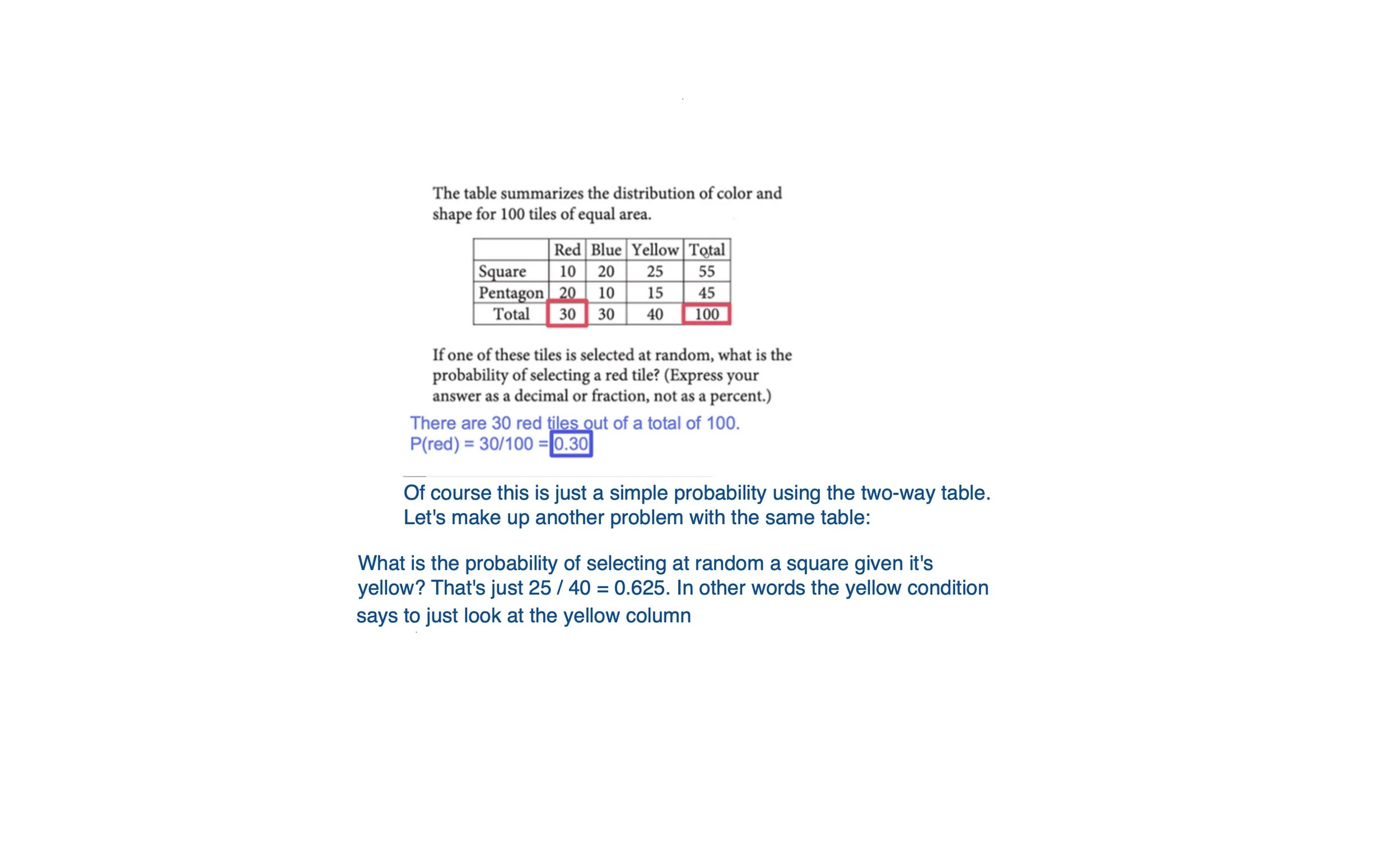
Two-way tables show the frequency of two categorical variables simultaneously. The SAT tests conditional probability from these tables.
Key skill — conditional probability: P(A | B) = (number in both A and B) / (total in B). This is read the probability of A given B. The denominator is the condition (the group you're restricting to), not the overall total.
Example: If a table shows 200 students, 80 of whom play sports, and 50 of those sport-players are seniors, then P(senior | plays sports) = 50/80, not 50/200.
Practice tip: Underline the condition in the problem. Find that row or column total and use it as your denominator. Do not use the grand total unless the problem asks for an unconditional probability.
Let’s try an example